Welcome

Featured

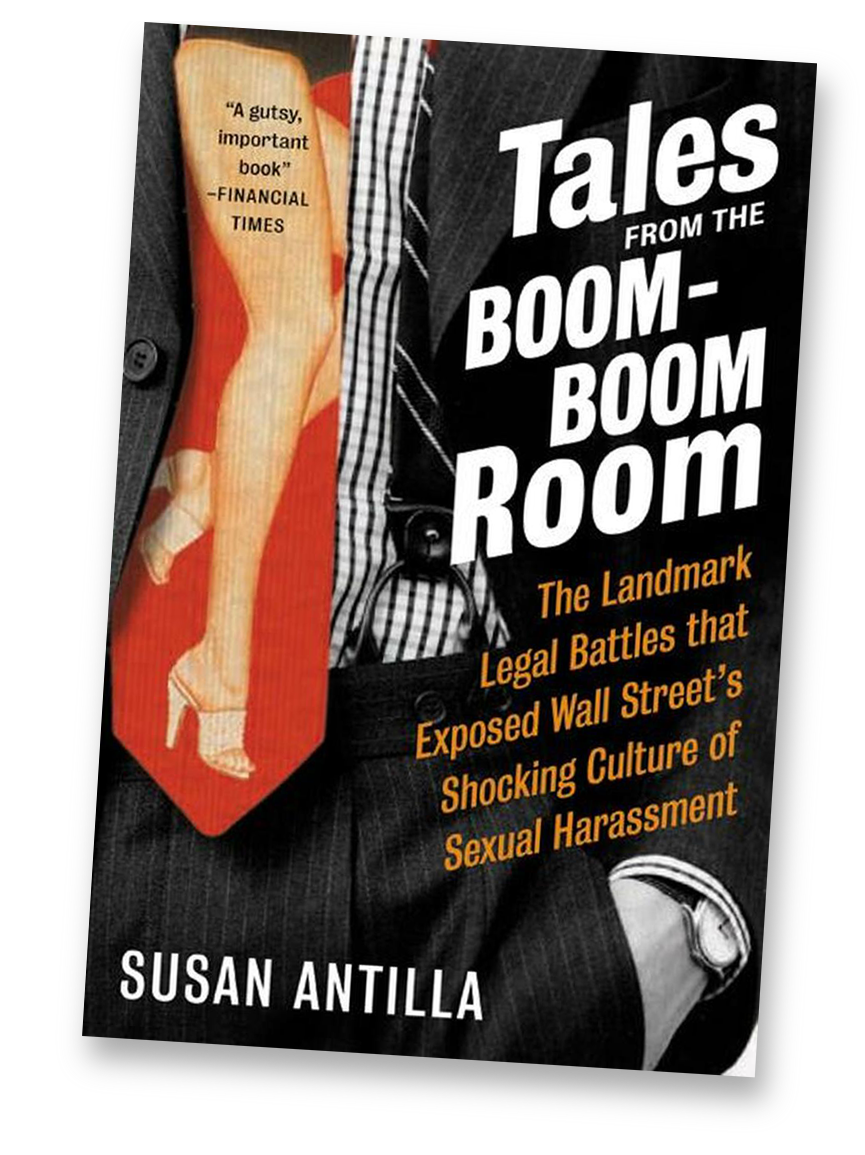
Susan Antilla is an award-winning journalist and author. She writes a monthly column for Bloomberg View and is a contributor to TheStreet.com. In 2002 she authored Tales From the Boom-Boom Room: The Landmark Legal Battles That Exposed Wall Street’s Shocking Culture of Sexual Harassment, a book that The New York Observer called “a work of compelling Wall Street anthropology.”

You can get in touch with her through her Twitter feed
or by email at Susan.Antilla15@gmail.com

Amaranth hit death spiral as sycophants, fools cavorted

The Greenwich, Connecticut hedge fund Amaranth Advisors LLC collapsed in September 2006 after losing more than $6 billion in the natural-gas futures market. I reviewed the new book about the debacle, “Hedge Hogs: The Cowboy Traders Behind Wall Street’s Largest Hedge Fund Disaster,” for Bloomberg Muse today. You can read it here.

How banks keep the lid on sex discrimination cases (and thus avoid having to change)

In my Bloomberg View column earlier this week, I wrote about the disconnect between image and reality when it comes to Deutsche Bank’s record on diversity. The Frankfurt-based global bank wins all those warm-and-fuzzy prizes for “Best Company” for working mothers, for example, but is the target of lawsuits brought by women who say are treated with nasty little barbs at work such as “Maybe I should get pregnant so I can work from home.”

Those same women say they endured more than Neanderthal-style comments from the guys: They say lost their jobs when they became mothers, too. Deutsche Bank dodged a bullet big-time when two women who were considering a class-action pregnancy discrimination suit settled with the bank earlier this year. In a court filing, the bank denied one of the pregnancy claims against it, and its spokeswoman Michele Allison declined to comment on the others.

Discrimination against women on Wall Street is a persistent problem that hasn’t been fixed despite an assortment of programs that purport to address it. Deutsche Bank, in fact, takes a deep bow for its programs around the world for women in finance. The bank says that 5,000 women from Deutsche and other firms attended their conferences for women last year alone.

Despite all the woman programs, diversity training and new “heads of diversity” jobs at financial firms, the lawsuits and internal investigations around gender discrimination just keep on coming.

Deutsche Bank is far from the only problematic bank out there — they all are. But  it does have some history that illustrates how hard financial firms work to keep the public from knowing how bad things are for their female employees. In a splashy lawsuit filed more than a decade ago, Virginia Gambale, a partner in Deutsche Bank’s Capital partners unit, said she was passed over for a promotion because of gender discrimination and that the bank’s work environment was hostile to women. She would wind up with a “multi-million dollar settlement,” according to a transcript of a court conference in her case.

Gambale’s lawsuit described a September 1999 business meeting she was required to attend in Cannes, France where approximately 100 men and 5 women had to walk past “a welcoming committee of ‘sex goddesses’ who were wearing revealing clothing that was highly inappropriate for a business meeting.” The complaint said that entertainment at the meeting included “a scantily clad Marilyn Monroe look-alike, who publicly fondled several male executives.”

The most interesting part of her lawsuit, though, were the lengths Deutsche Bank went to to avoid having information about the gender breakdown of salary and promotion at the bank become public. In an August 2, 2004 ruling by the U.S. Court of Appeals for the second circuit, Judge Robert D. Sack described some of the history around efforts by the bank to lock up documents.

During discovery, Deutsche Bank had produced compensation planning charts “and four pages of an internal Bank study of diversity at the Bank, which contained information about the gender composition of the Bank’s employees,” Sack wrote. The judge added that the bank had said the settlement was “motivated significantly by its desire to avoid public disclosure at trial of the temporarily sealed documents.”

Sack wrote that Harold Baer, the district judge in the case had “wondered aloud why the public should not know about discrimination at a major banking institution.” Baer told the bank that he’d disclose the contents of the settlement agreement unless Deutsche Bank agreed to hire a third party to do a global gender review and provide the results to the court. No way, said the bank, cooking up a stipulation of dismissal with Gambale to get the case out of Baer’s jurisdiction.

Over the years, I’ve spoken to a number of women who’ve taken settlements after years of emotional and expensive litigation. They get worn out, and often wind up feeling guilty that they didn’t fight to the bitter end in court so that the ugly details of gender differences in pay and promotion would be exposed. Those who can’t sue in court because of mandatory arbitration agreements don’t even get satisfaction when they win: Men who lose a discrimination or harassment case do not have to reveal that in their public “BrokerCheck” records. Is there any wonder the problems go on and on?

What we really need is a system that forces employers to report how many internal complaints they’re getting that allege discrimination, and how much men and women are being paid for doing similar jobs. We’ve got an Equal Employment Opportunity Commission, after all, and it’s time that agency’s mandate was expanded to demand those statistics. The way things work now, there are too many ways for banks and brokers to keep evidence of their discrimination under lock and key.

A bit of welcome news in all this: It turns out that six years after Gambale’s 2003 settlement, some of those Deutsche Bank documents were unsealed. They are not available electronically, but I’ve put in a request with a document service to get them. Look for another post when I’ve got them in hand.

Stockbrokers say the darndest things

I was at a local bank this morning, filling out the paperwork for a Certificate of Deposit, when I overheard a stockbroker in the next cubicle trying to answer questions from a worried elderly couple who’d come in with an account statement that had alarmed them.

“As long as you hold the CMO to term, you can’t lose money,” the broker said, referring to their investment in a collateralized mortgage obligation. I couldn’t help but wonder which would happen first — the maturity date of the CMO or the year of the couple’s estimated life expectancy.

I looked up at the bank officer who was doing the paperwork for my CD. “You guys sell CMOs?” I asked. Yes, indeed, she told me, not the least bit taken aback when I asked “Why are you selling risky stuff like that at your bank?”

He’s doing great!” she said of her huckster colleague, and I could hardly argue with that. “I’m sure he is,” I replied, my sarcasm going totally over her head.

I’d begun to scribble notes as the back-and-forth continued between the seniors and the broker. “It’s backed and guaranteed by the U.S. government,” the salesman told his customers. But the husband kept coming back with questions. “But the value’s gone down,” he said.

No sweat, the broker told him. That’s just partial return of your principal, he said. “This valuation number means nothing.” But no, the value’s gone down more than the amount of the principal repayment, the husband countered. “Pay no attention to the losses,” said the broker. “I have no concerns. This is the best buy in the industry.”

Best buy in the industry for the broker, maybe. Even if that investment winds up working out fine for the couple, they clearly didn’t understand what they’d purchased. And if they wind up losing, smart money says that broker will swear he never told those customers that anything about their CMO was “guaranteed.”

JPMorgan’s Teflon CEO Glides Past Reputation Hits

What does it take for investors and other supporters of a popular public company to finally decide the firm has gone too far in breaking the rules?

If you’re JPMorgan Chase & Co., it apparently takes more than a $6.2 billion trading blunder, a really embarrassing hearing before a Senate investigations committee, and a report that 8 federal agencies are circling you with probes.

In my column today for Bloomberg View, I write about the stunning ability of “The World’s Most-Admired Bank” to wallow in credit for all its good news, but slip by when the bad stuff happens.

“Steel City Re, a Pittsburgh-based firm that measures corporate reputations, ranks the bank in the 90th percentile among 50 financial conglomerates…Little wonder, I suppose, that earlier this year, JPMorgan topped the Fortune magazine list of most-admired banks in the world for the second year in a row. Are the bank’s admirers living in some parallel universe where black marks just don’t register?”


How does JPMorgan do it? You can read my column here.

After Boom-Boom Room, Fresh Tactics to Fight Bias

The headline-grabbing sex-harassment charges against Wall Street firms in the 1990s are a thing of the past, but not necessarily because things are better for women at financial firms.

In my story today for The New York Times, I discuss the progress — and lack of progress — since “The Boom-Boom Room” lawsuit against Smith Barney became synonymous with lurid behavior at brokerage firms.

Fast-forward 17 years, and such landmark cases are not as prevalent. Wall Street’s women are more aware of their rights and are not so timid anymore, says Linda D. Friedman, a partner at Stowell & Friedman. Still, she says her firm does a lot of work these days behind the scenes, assisting women who face discrimination but are reluctant to pursue litigation because of the repercussions it would have on their careers.


You may not be reading about these problems in your favorite newspaper or blog, but they’re still part of life for women who work in finance. You can read my story here.

Are you a lowly Main Street investor? Well, nobody cares what you think about financial reform

It’s never a great time to be a lowly member of the investing public looking for protection from the sharks of finance. But today? Well, try to lower your expectations a tad more.

Deep-pocketed banks are dominating the process of writing the new financial rules mandated by the Dodd-Frank Act. It isn’t that there’s nobody advocating for small investors. It’s just that the few organizations that make a case for the public are outgunned by the well-funded financial industry.

“Despite a significant expansion in the number of foot soldiers out there working in the public interest on these financial issues, we are still completely overwhelmed by the industry lobbyists,” Dennis Kelleher, chief executive officer of Better Markets, told me.

I wrote about the lopsided battle to influence the new financial rules in my Bloomberg View column tonight. You can read it here.


Don’t Skewer Sheryl Sandberg

There’s a lot of work to be done between here and equality for women. Rich women in good jobs have one set of problems and poor women have another. Women with children pile on a whole new set of challenges. And women most anywhere can tell you there’s still discrimination that needs to be fixed in the workplace.

So why do critics expect that Sheryl Sandberg, the chief operating officer at Facebook, would be able to solve every problem that women face in one book? I review Sandberg’s “Lean In: Women, Work and the Will To Lead” for Bloomberg Muse today. You can read it here.

Antilla columns get Commentary award

The Society of American Business Editors and Writers (SABEW) announced winners of its “Best in Business” journalism awards today. I’m honored to be on the list for my 2012 columns for Bloomberg View. You can see a list of all the winners here.

From the judges: “Susan Antilla’s sharp-edged commentaries give no quarter to those who mistreat investors or to the meek regulators who let offenders off easy. Her writing is crisp and eviscerating — two powerful traits when it comes to sharing opinions. Antilla demonstrates a shrewd understanding of the financial industry and its unsteady interaction with the federal government.”

Getting a little vertigo from the regulatory revolving door?

There’s been a lot of attention to the government-to-private practice “revolving door” since President Barack Obama nominated white-collar defense lawyer Mary Jo White to be chairman of the Securities and Exchange Commission.

Investor advocates say we should be worried when lawyers shuffle back and forth between jobs as regulators and lucrative spots defending banks and brokerage firms. But the lawyers who move in and out of government jobs say they can handle the conflicts just fine.

The New York City Bar Association had a panel to discuss “The Financial Crisis and the Regulatory Revolving Door” on Feb. 12 and moderator Scott Cohn of CNBC posed the question “Which is it?” Is it spinning out of control or is it non-existent?”

I was one of the six panelists, and cited a few gems from a just-released report by The Project on Government Oversight (POGO) that illustrated the close connection between the SEC and its alumni who’d moved on to represent the institutions the SEC regulates.

In an item about the panel on Feb. 19, POGO said “White’s nomination highlights the challenge that the SEC and many agencies face when senior officials have tangled ties to the industry they’re supposed to be regulating.” You can read the POGO post here.

I wrote about Mary Jo White’s conflicts in a recent column for Bloomberg View.

Your thoughts on the debate? Let me know at @antillaview or susan.antilla15@gmail.com.


Mary Jo White’s Past and the Future of the SEC

Have you been buying into the sales pitch for President Obama’s nominee for chair of the Securities and Exchange Commission?

Mary Jo White’s supporters say she was tough as U.S. attorney for the Southern District of New York, where she prosecuted mobsters and terrorists. From my column for Bloomberg View today:

She spent the past 10 years representing Wall Street, so she knows something about the legerdemain of banksters. And — insert violin solo here — she is a patriot, willing to give up millions of dollars in income as chairman of the litigation department at Debevoise & Plimpton LLP for a lousy government salary.”

Of course, the addition of “former SEC chairman” can only enhance her resume if and when she decides to go back to private practice. As for the idea that she might somehow be able to use her experience working for Wall Street to help crack cases as a regulator, I’m not buying it.

The SEC and Justice Department have had former defense lawyers checking in and out of top spots for years, and it hasn’t led to any big-bank carnage among the people who orchestrated flakey derivatives, self-destructing collateralized-debt obligations or other outrages. When was the last time you saw anyone from a well-known bank doing a perp walk for his role in the financial crisis?

You can read the full column here.

As always, I’m happy to hear from readers via Twitter or at susan.antilla15@gmail.com.


AIG’s Greenberg Thumbs Nose at Taxpayers

The man who made the insurance company AIG into an industry giant has written a book — The AIG Story — and if there’s one thing we learn from Maurice “Hank” Greenberg, it’s that Hank admires Hank.

The book, co-written with George Washington University law professor Lawrence Cunningham, describes Greenberg as “innovative” and “independent” and “pioneering.” I reviewed it for Bloomberg Muse today:

If you’re among the U.S. taxpayers who watched in horror as $182 billion of your money made its way to the collapsing insurance giant American International Group Inc. (AIG) during the financial crisis, it might come as a surprise to learn that your forced munificence didn’t make much of a difference. In his new book, “The AIG Story,” former chief executive Maurice “Hank” Greenberg offers his take on what kept the company alive: “It was saved only by the loyalty and tenacity of its valiant workforce,” he says.

You can read my full review here. But the main thing I came away with when I put  ”The AIG Story” down was what a disappointment it is when powerful people with inside access to world events miss an opportunity to pass on insights to the rest of us.

Surely, after a high-flying career befriending heads of state and moving AIG from an insurance runt to a world-wide behemoth, a man of 87 would have constructive insights about the near-collapse of the global economy. And, with a little luck, maybe even a bit of introspection about lessons he’s learned? Instead, we get 328 pages of finger-pointing and self- congratulation.

So there you have it. A wasted opportunity. But do take a look at the list of people willing to praise the book on the back cover, and consider adding them to the list of authors you needn’t follow. Amazon.com publishes the “praise” here.


A case of Wall Street greed gone too far

You hate paying taxes. I hate paying taxes. And the good folks at Goldman Sachs & Co. apparently hate paying taxes too. From my column this week for CNN.com:

“While the rest of us were donning our party clothes on New Year’s Eve, the legal worker bees at Goldman were pushing the send button on 10 regulatory filings to the Securities and Exchange Commission. By the time the ball dropped in Times Square, regulators had been notified that $65 million in Goldman stock had been granted a month early, helping a cluster of powerful multimillionaire executives trim their tax tab.”

Yes, I know. Can you blame them for taking perfectly legal means to avoid a bigger tax bill? Well, actually, yes.

“What makes the Goldman move distasteful is that it wasn’t even two months ago that CEO Blankfein was mouthing off in a Wall Street Journal op-ed that he endorsed tax increases “especially for the wealthiest” — along with a plug to cut entitlements to all you freeloaders out there.”

You can read my CNN column here.

Top stock picks of 2013 lose out to Honey Boo Boo

You’ve been reading them again, haven’t you? I’m talking about those annual “best investment ideas” that you’re seeing on every TV business show and in all your favorite newspapers, magazines, and blogs.

Stop reading them. Their advice stinks at least half the time, which means — at best — you lose half the time and win half the time. You do the math.

I wrote about the useless “Best ideas of 2013″ style articles in my latest column for Bloomberg: Top Stock picks of 2013 lose out to Honey Boo Boo:

“My advice? When you see one of those how-to articles, retreat to the kitchen for what’s left of the holiday eggnog and shut off the computer. If some TV stock jock is interviewing a Wall Street star about a best pick for the year ahead, grab the remote and surf for a rerun of “Here Comes Honey Boo Boo.” At least it won’t be you who is being exploited.”

You can read the story here.